



Most traders learn the bull call spread as “a cheaper call with capped upside”. That description is correct, and almost useless. It makes the cap sound like an unfortunate concession rather than the reason the trade can be better designed.
In this article, we use the supplied BTC $80,000/$90,000 bull call spread as a running example. The same position will show when a spread can be more efficient than a standalone call, how the capped payoff changes the reward-to-risk profile, what the Greeks actually mean, how to choose strikes and expiry, and when selling the upside is the wrong decision.
The strategy becomes interesting when your forecast has boundaries. You are bullish, but not blindly bullish. You expect BTC to reach a particular zone within a particular window. You want convex upside and a loss you can define before entry. Most importantly, you are willing to sell the upside beyond your target because you do not expect to need it.
A standalone call can be the expensive version of the same idea
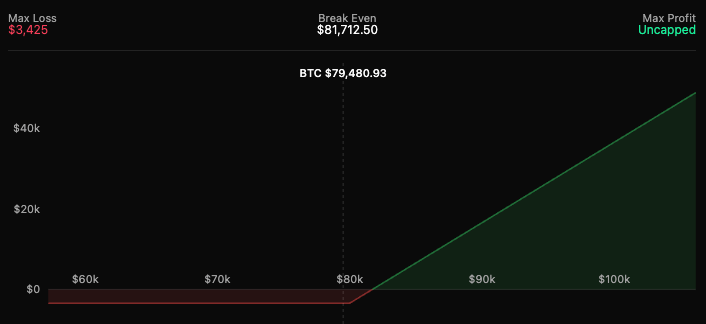
Buying a call preserves every dollar of upside above the strike, including the spectacular tail scenario. That optionality is valuable, but value is not the same as relevance. If your actual view is that BTC can break higher toward $90,000 by September 25, paying to participate at $100,000, $110,000, and beyond may mean buying outcomes that are outside the forecast you can defend.
A bull call spread removes that mismatch.
You buy the lower-strike call, then sell a higher-strike call with the same expiry. The premium received from the short call reduces the net debit. It also offsets part of the long call’s negative theta and positive vega. You retain bullish convexity through the target zone, but spend less on the open-ended tail.
BTC Call Spread: Risk $1,907 to make as much as $8,093
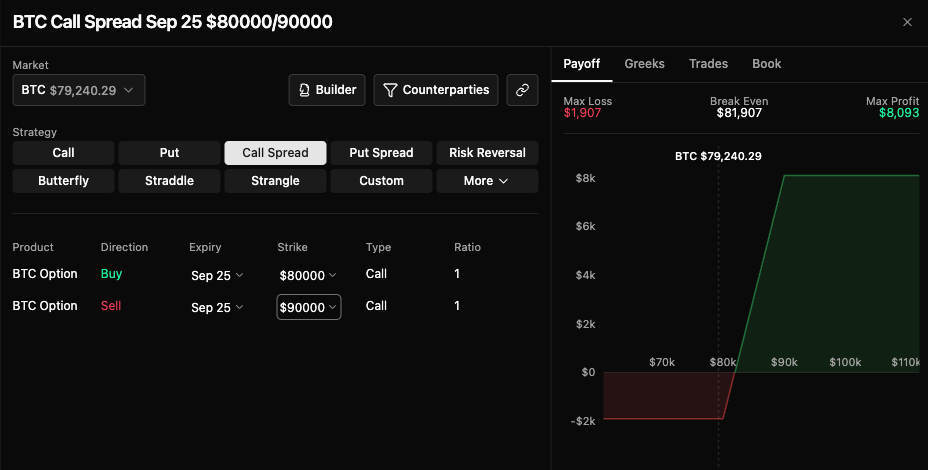
The supplied Derive builder shows BTC at $79,240.29 and a September 25 $80,000/$90,000 bull call spread:
- Buy the $80,000 call (Sep 25)
- Sell the $90,000 call (Sep 25)
The displayed maximum loss is $1,907. That is the net debit and, if the position is held to expiry, the most the spread can lose.
The strikes are $10,000 apart, so the spread’s maximum expiry value is $10,000. After subtracting the $1,907 debit, maximum profit is $8,093. That is roughly 4.24 times the capital at risk. Breakeven is $81,907, about 3.4% above the displayed spot price, while full profit requires BTC at or above $90,000, about 13.6% higher.
This is not merely an attractive chart. It is a precise market statement: BTC can travel from roughly $79,000 into the $80,000–$90,000 zone before expiry. The trade does not need a moonshot. It needs the forecasted move to happen on time.
Greeks: The spread begins with 0.37 delta without paying for the entire tail
The Greeks panel reports +0.37323 delta for the spread at the captured market snapshot. In directional terms, the position begins with a net delta of about 0.37 in the platform’s displayed conventions, although that exposure will change as spot, volatility, and time move. The spread is decisively bullish without behaving like a full unit of spot.
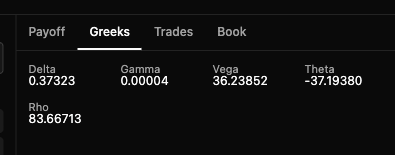
Figure 2. Builder Greeks at the supplied snapshot: delta 0.37323, gamma 0.00004, vega 36.23852, theta -37.19380, and rho 83.66713.
The builder also shows positive vega of 36.23852 and theta of -37.19380 in the platform’s displayed conventions. The position can still benefit from higher implied volatility and still pays for time, but the sold $90,000 call offsets some of both exposures relative to owning the $80,000 call alone. The spread is not theta-free or volatility-neutral; it is simply less dependent on paying for those exposures.
As BTC approaches $90,000, the short call gains delta and increasingly offsets the long call. Above the short strike near expiry, the two legs converge toward equal delta and the spread’s net directional exposure approaches zero. The position stops participating because the forecast has already reached the level at which it was designed to be complete.
How to build the spread around your forecast
1. Strike and expiry: Place the short call where your forecast ends
The defining decision is not the lower strike. It is the higher call you sell. The short strike should sit near the price at which you would be satisfied taking maximum profit, not at an arbitrary level chosen only because it makes the debit look cheap.
For this BTC spread, selling the $90,000 call says that a move to $90,000 by expiry is the objective. If $90,000 feels too conservative because you genuinely expect open-ended price discovery, the spread is probably the wrong expression. If $90,000 feels ambitious but plausible, selling that strike turns an uncertain bullish narrative into a testable trade.
The same discipline applies to expiry. A beautiful reward-to-risk ratio is meaningless if the target is unlikely to be reached in time. More time normally costs more and reduces the maximum payoff ratio, but it may produce the better trade if the catalyst or breakout window is uncertain. Expiry should follow the expected timing of the move, not the most flattering payoff graphic.
2. Volatility and timing: Cheap volatility helps, but the deadline matters more
Low implied volatility can make any long-premium position easier to finance, and the bull call spread can be attractive when upside options are not expensive. But cheap volatility is not the strategy’s defining setup. Because the spread sells one call against another, part of the volatility exposure is already offset.
The stronger setup is alignment among direction, destination, and deadline. You expect an upside move. You can name a realistic target. You have an expiry that gives the market enough time to get there. When those three elements are present, the spread expresses the forecast more faithfully than an unlimited call bought simply because “BTC should go higher.”
3. The trade-off: Efficiency can become expensive when you are too right
The spread’s advantage disappears if BTC explodes far beyond $90,000. A standalone $80,000 call would continue to gain above the short strike, while the vertical would remain capped at $8,093 of profit at expiry. In that scenario, selling the $90,000 call was not efficient—it surrendered valuable tail exposure.
That is the real trade-off. The bull call spread is not automatically better because it is cheaper. It is better only when the premium saved matters more than the upside surrendered. Traders expecting a fat-tailed breakout, an open-ended squeeze, or a new phase of price discovery may rationally prefer the standalone call.
The position can also lose the full debit if BTC finishes at or below $80,000, and a late rally after September 25 does not help. Two legs introduce more execution friction than one. The defined loss is an advantage, but it remains a real loss.
Why the best bullish trade may have a ceiling
A bull call spread is underrated because many traders treat uncapped upside as automatically superior. It is not. Upside that lies outside the forecast still has a price, and paying for it can make a targeted view less efficient.
For a trader who expects BTC to rally toward $90,000 by September 25, the $80,000/$90,000 spread offers a coherent exchange: cap the dream scenario, reduce the cost of the view, keep meaningful positive delta, and know the maximum loss before entry. The ceiling is not a defect hidden inside the strategy. It is the decision to buy only the upside you expect to use.
Disclaimer
This material is for informational and educational purposes only and does not constitute investment, financial, legal, or tax advice. Nothing in this article is an offer, solicitation, or recommendation to buy or sell any asset or derivative. Options involve substantial risk and may not be suitable for all investors. Prices, Greeks, volatility, liquidity, fees, settlement mechanics, and execution conditions can change materially, so actual results may differ from the examples shown. Past or hypothetical performance is not indicative of future results. Always conduct your own research and assess your objectives, financial circumstances, and risk tolerance before trading.


