



You set cash aside, sell a put below the market, and get paid upfront for taking on the risk that BTC falls to that level.
It is the most conservative way to be short an option, as long as the cash is genuinely set aside.
What a Cash-Secured Put Actually Does
Selling a put is a bet that the underlying finishes above a chosen price on a chosen date. If it does, the option expires worthless and the premium is yours. If it does not, you pay the difference between the strike and where the market settles.
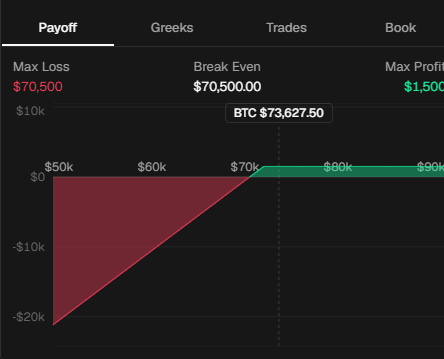
If you read the covered call article, the shape will look familiar. The gain is capped at the premium, and the downside below the strike is open. Both trades share the same payoff profile.
One point needs to be clear, because the strategy is usually described differently elsewhere. On venues that deliver the underlying, a put that finishes in the money leaves you holding the asset, which is why the trade is often framed as getting paid to place a bid. Derive settles in USDC. A put that finishes in the money costs you cash, and no BTC arrives in the account.
The economics are the same as buying at the strike and marking to the settlement price. The mechanics are not. If the point of the trade is to end up holding BTC, you still have to buy it.
Example
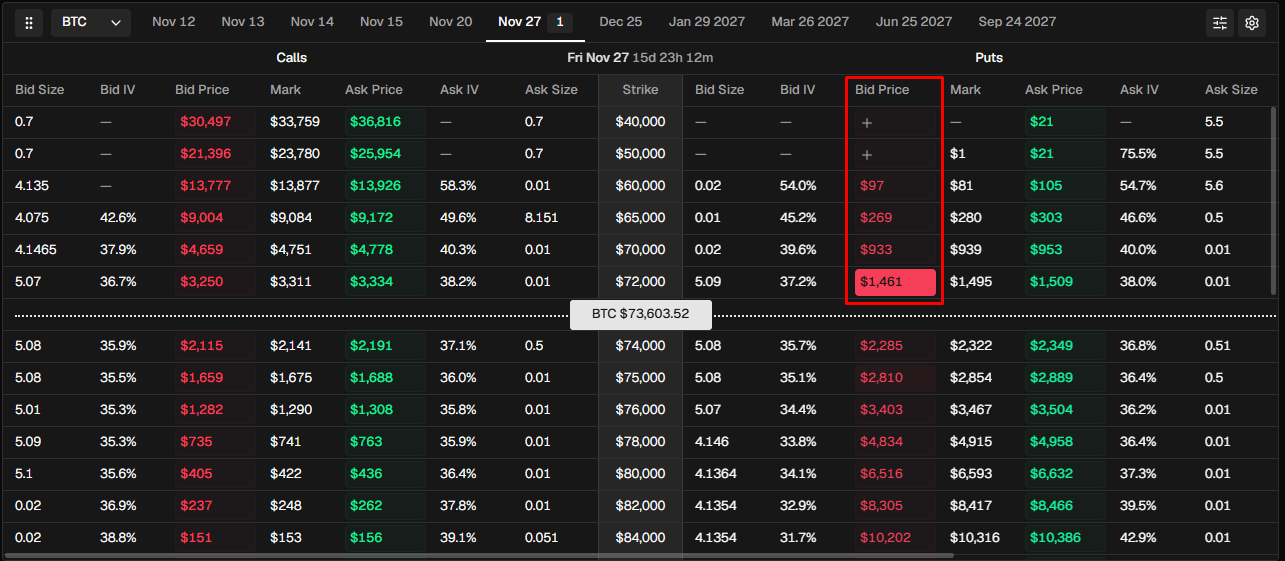
- BTC is trading around $73,700
- You sell the $72,000 put expiring 27 November, 16 days out
- The bid is about $1,450 per BTC, so a 0.1 size collects $145
- Covering it in full means setting aside 0.1 times $72,000, which is $7,200 in USDC
That is about 2% on the cash set aside, for 16 days. Your breakeven is the strike minus the premium: $70,550.
BTC finishes above $72,000: The put expires worthless and you keep the $145. Nothing settles and the cash you set aside is free again. This is the outcome the trade is built for.
BTC finishes between $70,550 and $72,000: The put settles in the money, but the amount deducted is smaller than the premium you collected. The trade is still net positive.
BTC finishes below $70,550: The settlement is larger than the premium and the trade is a loss. At $68,000, 0.1 times $4,000 settles against you, which is $400. Minus the $145 collected, that is a loss of $255. Every further dollar of downside is a dollar off the result, up to a maximum loss of $7,055 if BTC went to zero.
How to Sell a Cash-Secured Put on Derive
- Fund the account with USDC.
- Open the options chain and select an expiry.
- Pick a strike below the current spot price. Strikes close to spot pay more premium and are reached more easily. Strikes further below pay less and need a larger fall. On the 27 November board, the $70,000 put pays about $920 per BTC, against $1,450 for the $72,000.
- Click the row on the put side to load it into the trade form.
- Select Sell to Open, enter your size, and check the premium received and the margin required before submitting.
- Once filled, the position appears under Positions with live PnL and Greeks.
When Does Selling a Cash-Secured Put Make Sense?
A cash-secured put fits when you would be a willing buyer lower down and would rather be paid to wait than sit in cash. It can make sense if you:
- Would genuinely buy BTC at the strike, not just like the premium
- Expect the market to hold above a level you can name, or to drift sideways
- See put implied volatility running high, since that is when puts pay the most. On the chain, IV rises as strikes go lower: the market pays extra for downside protection, and the seller collects it
- Have USDC sitting idle with no better use over the next few weeks
It is a poor fit in two cases:
If you are strongly bullish, your gain stops at the premium while BTC keeps going. If you expect a sharp fall, the premium will not cushion it. Selling puts into a market you think is about to break is selling insurance on a burning building.
It also behaves differently from a limit buy order. A limit order fills as soon as the price touches it. The put only counts at settlement. If BTC dips below your strike and recovers before expiry, the limit order would have bought the dip, while the put simply keeps its premium.
What Are the Risks?
The premium is small and the loss is not. A short put collects a fixed amount and accepts a loss that grows with every dollar of downside, so the trade produces many small wins and the occasional large loss. Sizing matters more here than in anything covered so far.
There is no delivery, so this is not an accumulation strategy on its own. A put that settles against you produces a cash loss, not a position in BTC.
The margin requirement rises at lower prices. A fast fall increases the margin needed on the short put exactly when the position is already losing. Holding the full strike value in USDC is what keeps that from becoming a problem.


