



You buy a put, sell a cheaper one further below, and pay less for a bearish view than a plain put would cost.
In return, the payout stops at the lower strike. That makes it a trade for a fall you can size, not for a crash.
What a Put Spread Actually Does
A put spread is two puts on the same expiry. You buy one at a higher strike and sell one at a lower strike. The put you buy gains as BTC falls. The put you sell pays for part of it, and in exchange gives up everything below its strike.
If you read the call spread article, this is the same construction turned around. The call spread paid for a move up to a target. The put spread pays for a move down to one.
Both sides of the trade are fixed before you enter. The most you can lose is what you pay. The most you can make is the distance between the strikes minus what you pay.
Derive settles in USDC. At expiry the spread pays the difference between the upper strike and the settlement price, capped at the width of the spread, in cash. Nothing is delivered either way.
Example
- BTC is trading around $64,550
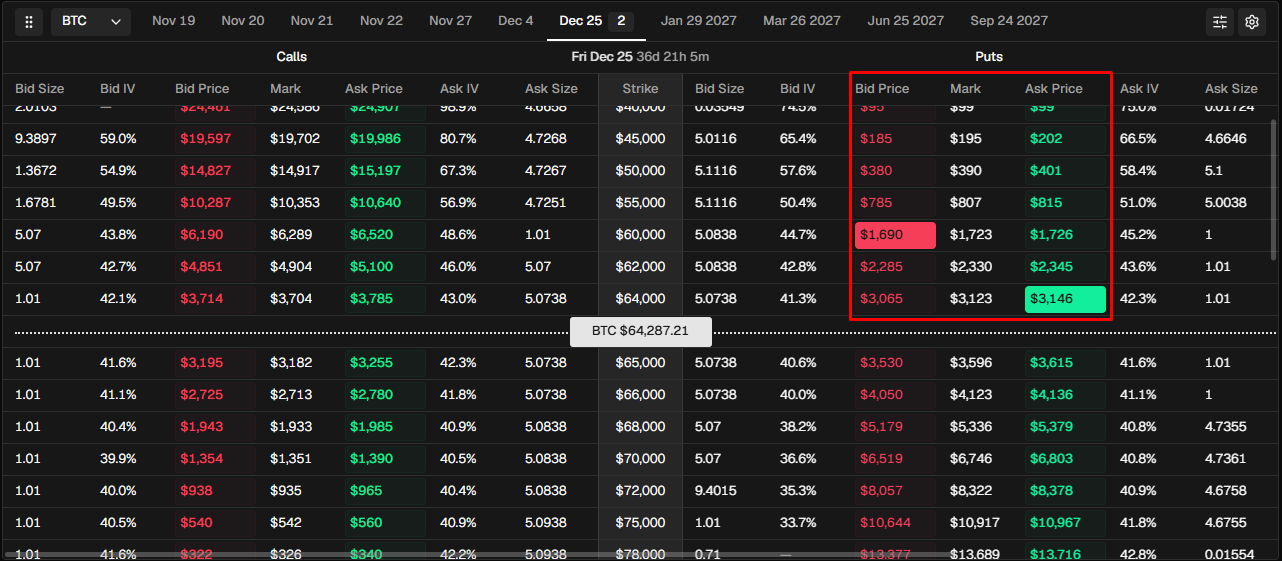
- You buy the $64,000 put expiring 25 December, 37 days out, at the $3,017 ask
- You sell the $60,000 put on the same expiry at the $1,597 bid
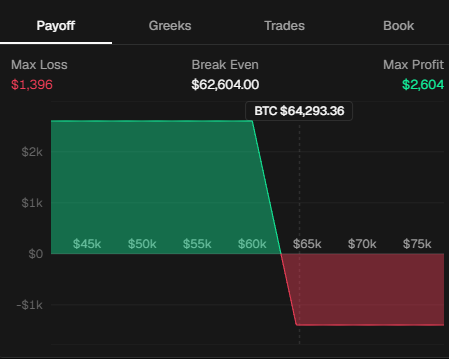
- The net cost is $1,420 per BTC, so a 0.1 size costs $142
On its own, the $64,000 put would cost $302 for the same 0.1 size. The spread costs less than half of that. It is $4,000 wide, so the most it can pay on 0.1 is $400. Your breakeven is the upper strike minus the net cost: $62,580, about 3% below spot.
BTC finishes above $64,000: Both puts expire worthless and the $142 is gone. That is the maximum loss, and nothing else is owed.
BTC finishes between $60,000 and $64,000: The put you bought settles in the money and the put you sold expires worthless. Above $62,580 the payout is smaller than the cost and the trade is a partial loss. Below it the trade is positive. At $62,000, the spread pays 0.1 times $2,000, which is $200. Minus the $142 paid, that is a gain of $58.
BTC finishes at or below $60,000: Both puts settle in the money, and the one you sold offsets every dollar below $60,000. The spread pays its full $400. Minus the $142 paid, that is a profit of $258, about 1.8 times the amount at risk. A further fall adds nothing.
How to Set Up a Put Spread on Derive
- Fund the account with USDC.
- Open the options chain and select an expiry.
- Pick the put you buy. A strike close to spot starts paying with the first part of a fall. On the 25 December board, the $64,000 put sits just below spot at $3,017.
- Pick the put you sell, at the level where you expect the fall to end. The gap between the two strikes sets both the cost and the maximum payout. A 64,000/62,000 spread costs about $834 per BTC and pays at most $2,000, against $1,420 and $4,000 for the 64,000/60,000.
- Put both legs on the same ticket: Buy the upper put and Sell the lower put, with the same size. Check the net cost, maximum loss, maximum profit and breakeven before submitting. Sending both legs together, or as one RFQ, avoids filling one leg without the other.
- Once filled, the position appears under Positions with live PnL and Greeks.
When Does a Put Spread Make Sense?
A put spread fits when you expect BTC to fall and can say roughly how far. It can make sense if you:
- Expect a decline to a level you can name, before the option expires
- Find a plain put too expensive for the move you expect
- See steep put skew on the chain. Lower strikes trade at higher implied volatility, so the put you sell is priced relatively rich. On the 25 December board, the $60,000 put bids at 44.4% IV, against 42.2% on the ask of the $64,000
- Want the maximum loss fixed before you enter
It is a poor fit in two cases:
If you expect a crash, the cap gets in the way. The plain $64,000 put overtakes the spread once BTC settles below about $58,400, and every further dollar of downside widens the gap. If you are unsure about direction, the spread loses its full cost whenever BTC stays above the upper strike, and time works against it while you wait.
Only the settlement counts. If BTC drops to $59,000 in early December and recovers above $64,000 by 25 December, a spread held to expiry pays nothing. Closing early locks in what the spread is worth at that moment.
What Are the Risks?
A defined loss is still a loss. If BTC settles above $64,000, the whole debit is gone. Knowing the number in advance does not make it smaller.
Two legs mean two fills. Entering one leg at a time can leave you holding only the short put for a moment, and a short put on its own has open downside. Send both legs together.
Before expiry, the spread is worth less than its width. Even with BTC below $60,000, both puts still carry time value, and closing early returns less than the full $4,000 per BTC until expiry gets close.


